
Personal Training through the menopause in Stratford-upon-Avon: what actually works
Here’s the fitness advice most women going through menopause get: join a yoga class. Go for walks. Don’t push too hard. Listen to your body.
That advice isn’t wrong, exactly. But it’s not nearly enough — and for a lot of women, it’s actually part of the problem. Because the message underneath it is: your best training years are behind you. Wind it down. Be gentle with yourself now. Abi disagrees with that entirely.
Why standard fitness advice fails women going through the menopause
Most fitness advice wasn’t designed for women in perimenopause or post-menopause. It was designed for younger women, or for men, and then adjusted slightly. The hormonal reality of what happens to your body during and after menopause — how it changes your metabolism, your recovery, your response to exercise, your relationship with body fat — is routinely ignored.
The result is that women in their 40s and 50s follow the same plans they’ve always followed, get worse results than they used to, and conclude that their body has betrayed them. In reality, the plan has failed them.
Most personal trainers aren’t much help here either. A trainer in their mid-20s with a Level 3 certificate has learned about menopause from a textbook. They haven’t lived it. They don’t know what it feels like to train hard, eat well, do everything right — and still find that things aren’t responding the way they used to. That gap between what they know academically and what you’re actually experiencing tends to show up in the quality of the programme they write you.
There is a better option. But it starts with understanding what’s actually happening.
What actually happens to your body
Menopause is the point at which oestrogen and progesterone levels drop significantly — usually in your late 40s to early 50s, though surgical menopause following a hysterectomy can happen at any age. That hormonal shift has real, measurable effects on your body.
You lose muscle mass faster and build it more slowly. Fat redistribution, particularly around the abdomen, becomes more pronounced. Bone density decreases. Recovery from exercise takes longer. Sleep is often disrupted, which compounds everything else.
None of this is inevitable decline. It’s a change in the conditions you’re working with. The right training approach accounts for it — and actually, for many women, the post-menopause years can be some of their strongest if the programme is built correctly.
Why our founder, Abi Boddington, is different
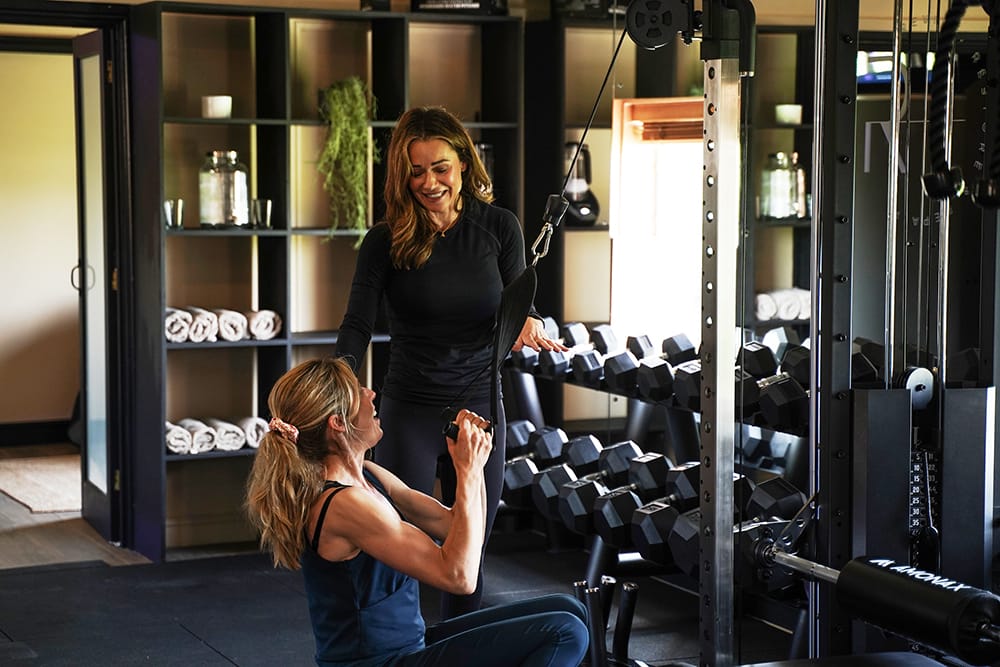
Abi is 47. She has trained her whole life — competed in CrossFit, competed in Hyrox, and applied serious, evidence-based nutrition knowledge to her training for decades.
She also had a full hysterectomy, which put her into surgical menopause. So when she talks to clients about what menopause does to your training, she’s not reading from a textbook. She knows exactly what it feels like to go through significant hormonal change while trying to maintain the fitness she’d spent years building. She knows what worked, what didn’t, and what the advice she was given got wrong.
She didn’t gain weight. She didn’t lose her fitness. She came out the other side with a clearer understanding of her body than she’d had before — and with a methodology she now applies to the women she trains.
That’s not a marketing line. It’s just her story.
What it means practically is that when a client comes to Abi and says “I’m eating the same way I always have and suddenly gaining weight” or “I’m sleeping badly and my recovery feels shot,” Abi doesn’t offer generic reassurance. She knows what’s happening, why it’s happening, and what to change.
As a personal trainer menopause Stratford-upon-Avon clients trust, Abi brings something most trainers genuinely cannot: she’s been there.
What a menopause-aware training programme looks like
The single biggest mistake in menopause fitness programmes is overemphasising cardio and underemphasising strength.
Cardio has its place. Cardiovascular health matters at every age. But long, steady-state cardio is not going to address the muscle loss that menopause accelerates, and it won’t protect your bone density. Strength training does both. Done correctly, it also improves insulin sensitivity — which directly affects how your body stores and uses fat.
A programme built around menopause-aware principles looks something like this:
Strength training at its core
Not bodybuilder-style training with strict splits, but functional, progressive strength work that builds real-world capacity. Squats, deadlifts, pressing movements, rows. The kind of training that keeps you capable for decades, not just the next few months.
Recovery treated as part of the programme, not an afterthought
Because recovery is slower post-menopause, training that doesn’t account for it leads to accumulated fatigue and, often, injury. Abi builds recovery into the programme from the start — structuring sessions so that your body has time to adapt before the next load.
Nutrition adjusted for the hormonal environment you’re in now.
The eating patterns that worked in your 30s may not be right for your 40s and 50s. Protein requirements increase with age. Carbohydrate timing can matter more. Abi’s nutrition knowledge is practical, not theoretical — she works with what you actually eat and makes adjustments that are sustainable.
Progress measured beyond the scale.
Weight is one data point. Strength, endurance, sleep quality, energy levels, how your clothes fit, how you feel walking up stairs — all of these matter. Abi tracks the things that actually tell you how the programme is working.
How RRR’s therapies support menopausal women
One of the things that makes training at Revive Restore Repair in Stratford-upon-Avon different from working with a PT elsewhere in Warwickshire is what happens after the session.
The RRR therapy suite includes hyperbaric oxygen therapy (HBOT), cryotherapy, and red light therapy. For women going through or past menopause, each of these has specific value.
HBOT increases the oxygen concentration in your bloodstream, which supports tissue repair and reduces inflammation. Menopause increases systemic inflammation — it’s one of the reasons recovery feels harder than it used to. HBOT can help your body recover from training sessions more efficiently, which means you can train more consistently.
Cryotherapy reduces inflammation rapidly and has a genuine effect on how quickly your body bounces back from exercise. Many of Abi’s clients who combine PT sessions with Cryotherapy report that delayed-onset muscle soreness — the ache that follows a hard session — is noticeably reduced.
Red light therapy operates at a cellular level, supporting mitochondrial function and tissue repair. It has also been associated with improvements in sleep quality — which for menopausal women dealing with disrupted nights is genuinely useful beyond its recovery benefits.
You don’t have to add any of these to your programme. But if you want to, they’re right here. You can finish a session with Abi and step into the therapy suite in the same visit. No separate appointments, no separate journey.
What Abi’s clients tell us
Every woman’s experience is different. Some come to Abi having avoided the gym for years, others come mid-menopause having found that what they’d always done had stopped working. Others are post-surgical, rebuilding from a point where they’d been told to rest and weren’t sure how to get started again.
Many of Abi’s clients report that within the first two months of training consistently with a programme designed for where they actually are, their energy improves noticeably. Sleep quality tends to follow. Strength comes faster than most expect, particularly in the early weeks when the nervous system is adapting to the demands of structured training.
The longer-term results — improvements in body composition, bone density support, sustained energy — take more time. But the clients who stay with a properly designed programme typically report that at 50 or 55 they feel physically stronger and more capable than they did at 45. That’s not unusual. It’s what happens when training and nutrition are actually aligned with your body.
Frequently Asked Questions
What results can I expect from personal training during menopause?
Every woman’s experience is different. Many of Abi’s clients report that within the first two months of training consistently with a programme designed for where they actually are, their energy improves noticeably. Sleep quality tends to follow. Strength comes faster than most expect, particularly in the early weeks when the nervous system adapts quickly. What changes more slowly — but more meaningfully — is how you feel about your body. Not its appearance, but what it can do. The scale is rarely the right measure. What most clients notice is that things that felt hard stop feeling hard.
Is it safe to train intensely during menopause?
Yes, for most women — and in fact, resistance training at a meaningful intensity is one of the most evidence-backed interventions for managing the physical effects of menopause. The key is that intensity should be appropriate to your current fitness level and recovery capacity, and it should be progressed sensibly. Abi programmes this carefully. Women who are post-menopause are not fragile — they respond to training stimulus just as women at any other stage of life do, with proper recovery built in.
Can personal training help with weight gain during menopause?
Yes, though it’s worth being clear about what “help” means. Menopause-related weight gain, particularly around the abdomen, is hormonally driven — it isn’t simply a matter of eating more or moving less. A programme that includes strength training, appropriate nutrition guidance, and adequate recovery can significantly improve body composition and make it much easier to maintain a healthy weight. It won’t override your hormones, but it works with them rather than against them.
How is training after a hysterectomy different?
A hysterectomy, particularly a total hysterectomy, results in immediate surgical menopause if the ovaries are removed. The hormonal changes are abrupt rather than gradual, which can make the physical effects more pronounced initially. There are also specific considerations in the early recovery period around intra-abdominal pressure and core rehabilitation before returning to loaded training. Abi has personal experience with this and builds programmes that address it properly — starting with what your body can handle and progressing from there.
GET IN TOUCH
Book a free consultation
Every recovery journey is unique and we’ll create your tailored protocol adjusted to your needs — whether you need more oxygen therapy for healing, red light for tissue repair, or cryotherapy for energy and mood.

© 2026